
Boxing Odds Explained: How to Read Fractional, Decimal, and American Formats
 Available in US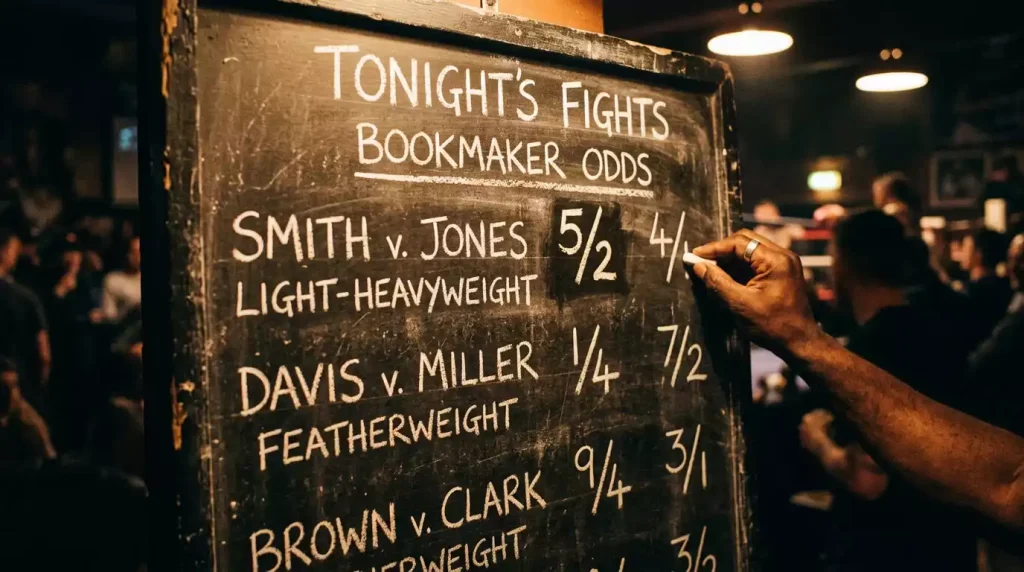
I still remember the first boxing bet I placed — a tenner on Ricky Hatton at 4/1, written on a slip at a Ladbrokes counter in Manchester. I had no idea what 4/1 actually meant beyond “I get more than my money back if he wins.” That ignorance cost me more than the bet itself, because for years afterwards I kept picking fighters without understanding whether the price was fair, generous, or an outright trap. Odds are not just numbers attached to a name. They are the bookmaker’s entire argument about a fight compressed into a single fraction, decimal, or plus-minus figure — and if you cannot read that argument, you are betting blind.
Across the UK, roughly 10% of the adult population places sports bets online, and 76% of punters aged 18 to 24 do so exclusively through a mobile phone. That means most people encounter boxing odds on a small screen, often minutes before a fight, scrolling past columns of fractions they have never been taught to interpret. The default format at UK bookmakers is fractional — 5/2, 11/4, 1/8 — but every major app now lets you switch to decimal or American with a single tap. The problem is not access to the numbers. The problem is knowing what the numbers actually tell you about probability, value, and your potential return.
This guide strips odds back to first principles. I will walk through each of the three major formats, show you how to convert between them, explain how bookmakers build their profit margin into every price, and lay out the forces that shift boxing odds in the days and hours before a bell rings. By the end, you will read a betting slip the way I read a fight card — not as a list of names, but as a map of probabilities with real money attached to every line.
Fractional Odds: The UK Standard
A few years back I was at a pub near York Hall on fight night, and the bloke next to me asked if 7/2 meant he would get seven pounds for every two he staked — or two pounds for every seven. That confusion is universal, and it is the single biggest barrier for new boxing bettors in Britain. Fractional odds have been the language of British bookmaking for over a century, yet nobody seems to teach them properly.
The rule is simple. The number on the left is your profit. The number on the right is your stake. At 7/2, a two-pound bet returns seven pounds of profit plus your original two back — nine pounds total. At 1/4, every four pounds staked earns one pound of profit, returning five. The fraction is a ratio of reward to risk. Nothing more.
Where it gets interesting for boxing is the range. Football match odds tend to cluster between evens and 5/1 for most outcomes. In boxing, you regularly see a dominant champion priced at 1/10 or even 1/20 — meaning you need to stake ten or twenty pounds to win a single pound of profit. At the other end, a genuine underdog on a world-title card might sit at 14/1 or 25/1. That width tells you something fundamental about how the market views the fight: the narrower the fraction, the more lopsided the expected outcome.
Fractional odds also expose when a bookmaker is offering you a better or worse deal than a rival. If one operator prices a fighter at 5/2 and another at 11/4, the second is giving you fractionally more profit per pound staked. Converting those to a common denominator — 10/4 versus 11/4 — makes the comparison instant. This kind of mental arithmetic becomes second nature once you start thinking in fractions rather than just scanning for names you fancy.
One detail that trips people up: odds-on prices. When the first number is smaller than the second — 4/9, 2/7, 1/3 — the fighter is favoured. Your profit will be less than your stake. These prices dominate boxing, because most bouts feature a clear favourite. In nine years of tracking odds, I have noticed that roughly two-thirds of all boxing markets open with at least one fighter at odds-on. Understanding that dynamic is essential before you ever click “place bet.”
There is one more subtlety worth flagging. Traditional fractional odds do not include your stake in the displayed number. When you see 5/2, that five is pure profit — your two pounds come back on top. This seems obvious once you know it, but I have seen experienced punters confuse total return with profit when comparing across formats. Keep the distinction sharp and you will avoid a category of error that silently eats into long-term results.
Decimal Odds and Why Exchanges Use Them
The first time I used Betfair Exchange seriously, I switched to decimal odds and never looked back for exchange work. Decimals strip away the mental gymnastics of fractions because the number you see is your total return per pound staked — stake included. A price of 3.50 means every pound returns three pounds fifty. A price of 1.25 means every pound returns one pound twenty-five. Done.
Exchanges default to decimals for a reason. When you are both backing and laying outcomes — effectively acting as punter and bookmaker simultaneously — you need a format that lets you compare returns instantly across dozens of runners. Fractional odds require you to hold numerators and denominators in your head; decimals give you a single multiplier. Multiply your stake by the decimal, and the result is your total payout. Subtract the stake, and you have your profit. Two operations, no ambiguity.
Converting from fractional to decimal is straightforward. Divide the numerator by the denominator and add one. So 5/2 becomes (5 / 2) + 1 = 3.50. And 1/4 becomes (1 / 4) + 1 = 1.25. Going the other direction — decimal to fractional — subtract one, then express the result as a fraction reduced to its simplest form. Decimal 4.00 minus one is 3.00, which is 3/1. Decimal 2.20 minus one is 1.20, which is 6/5.
For boxing specifically, decimals shine when you are comparing tight odds-on fighters. A champion at 1/8 fractional becomes 1.125 decimal; the same champion at 1/10 becomes 1.10. In fractional form those look almost identical. In decimal, the difference — 0.025 per pound — jumps out immediately and might matter across a large stake. If you are building a boxing accumulator, decimal prices multiply cleanly: 1.50 x 2.00 x 1.80 = 5.40, your combined decimal odds for the parlay. Try doing that with 1/2, evens, and 4/5 in your head.
One thing to keep in mind: decimals can feel deceptively small. A price of 1.05 looks negligible until you realise it means the market believes that fighter has roughly a 95% chance of winning. In boxing, where a single punch can change everything, that 5% tail risk is not negligible at all. Decimals make probabilities easier to feel intuitively — anything close to 1.00 is near-certain, anything above 5.00 is a serious longshot, and the midrange between 2.00 and 4.00 is where most competitive fights live.
American Odds: Reading Lines from US Sportsbooks
Every time a major US-promoted fight hits the schedule — and in 2026 that happens constantly, with cross-Atlantic super-fights pulling in UK money — social media floods with American odds that half of British punters cannot parse. You will see lines like -350 and +280 and wonder why anyone would choose to express a price that way. The logic is simpler than it looks, but it operates from a different starting assumption than either fractional or decimal formats.
American odds pivot around a baseline of 100. A negative number tells you how much you need to stake to win 100 units of profit. A positive number tells you how much profit you win from a 100-unit stake. So -350 means you stake 350 to win 100 profit. And +280 means a 100 stake wins 280 profit. The negative sign marks the favourite; the positive sign marks the underdog. There is no ambiguity about which side of the market you are on.
Converting American to decimal depends on the sign. For favourites (negative): divide 100 by the absolute value, then add one. So -350 becomes (100 / 350) + 1 = 1.286. For underdogs (positive): divide the number by 100, then add one. So +280 becomes (280 / 100) + 1 = 3.80. From there you can convert to fractional if you prefer — decimal 1.286 is roughly 2/7 fractional, and decimal 3.80 is 14/5.
Why bother learning a format designed for a different market? Because the best boxing odds do not always come from UK bookmakers. Occasionally a US sportsbook — accessible to UK punters through international platforms — will offer a materially better price on a fighter, expressed in American format. If you cannot read -150 as quickly as you read 4/6, you will miss those windows. Speed matters when odds are shifting in the hours before a weigh-in.
American odds also show up in boxing media constantly. When a journalist writes that a fighter “opened at -800,” they are telling you the market considered that fighter an overwhelming favourite — equivalent to 1/8 fractional or 1.125 decimal. If you follow boxing coverage from ESPN, The Athletic, or DAZN’s own editorial team, you will encounter these lines daily. Fluency in all three formats is not optional for a serious bettor; it is the baseline literacy that makes everything else — value identification, line comparison, probability modelling — possible.
Converting Odds to Implied Probability
Here is where odds stop being about payouts and start being about truth. Every price a bookmaker offers contains an implied probability — the market’s estimate of how likely that outcome is. Once I learned to extract that number, my entire approach to boxing betting changed. I stopped asking “who do I think wins?” and started asking “does the market agree with my assessment, and by how much?”
The formula for converting decimal odds to implied probability is: 1 divided by the decimal odds, multiplied by 100. A fighter priced at 2.50 decimal has an implied probability of (1 / 2.50) x 100 = 40%. A fighter at 1.33 decimal has an implied probability of (1 / 1.33) x 100 = 75.2%. For fractional odds, the formula is: denominator / (numerator + denominator) x 100. So 5/2 fractional gives you 2 / (5 + 2) x 100 = 28.6%.
These percentages are the real currency of betting. When a bookmaker prices a heavyweight at 1.50 decimal — implied probability 66.7% — they are saying this fighter wins roughly two out of every three times this bout is fought. If your own analysis says the fighter wins 80% of the time, the gap between 66.7% and 80% is your edge. That gap is where profit lives.
The UK remote betting sector generated GGY of 2.4 billion pounds last year, and every penny of that came from situations where the bookmaker’s implied probabilities were, on average, slightly more accurate than the betting public’s estimates. Your job as a bettor is to find the fights where the public has pushed the line away from reality — and implied probability gives you the tool to measure exactly how far.
Let me walk through a concrete example. Suppose Fighter A is priced at 4/7 fractional (1.571 decimal) and Fighter B at 6/4 fractional (2.50 decimal). Fighter A’s implied probability: 7 / (4 + 7) x 100 = 63.6%. Fighter B’s implied probability: 4 / (6 + 4) x 100 = 40%. Add them together: 63.6 + 40 = 103.6%. That total exceeds 100%, and the excess — 3.6 percentage points — is the bookmaker’s margin. We will dig into that margin in the next section, but the key lesson here is that implied probabilities from a single bookmaker always sum to more than 100%. The overshoot is the house edge baked into every market.
Andrew Rhodes, Chief Executive of the UK Gambling Commission, noted that online betting patterns closely follow the rhythm of major events — when a marquee boxing card lands, participation spikes and GGY tracks the results. What he did not say, but what the data implies, is that those spikes bring in casual money that often misprices outcomes. That is the window where an informed bettor armed with implied-probability calculations finds the most value. The crowd floods in, the lines shift, and if you have done the work, you can see exactly where the crowd has it wrong.
The Bookmaker’s Overround and Margin
A question I get asked constantly: if betting is just probability, why does the house always win? The answer is the overround — the built-in margin that ensures a bookmaker profits regardless of the outcome. Understanding this margin is not academic. It is the single most practical concept in odds analysis, because it tells you exactly how much of every pound you stake is being skimmed before the fight even starts.
The overround works like this. In a two-outcome boxing market — Fighter A versus Fighter B, ignoring the draw — the true probabilities of all outcomes must sum to exactly 100%. But the bookmaker’s implied probabilities, as we saw, sum to more. If the total is 105%, the overround is 5%. That 5% is the operator’s gross margin on the market. In practice, boxing overrounds at UK bookmakers typically range from 3% to 8% for main-event moneyline markets, and can climb to 12% or higher for exotic props like exact round of stoppage.
Why does this matter for your betting? Because the overround is not distributed evenly. Bookmakers tend to load more margin onto the underdog’s price than the favourite’s. A favourite at 1/3 might carry a true probability of 73%, but the bookmaker prices them at an implied 76%. The underdog at 5/2 might have a true probability of 27%, but gets priced at 29%. The extra percentage points on each side add up to the overround, but the underdog absorbs more of the distortion. This asymmetry is worth knowing because it means underdog prices are often further from “fair” than favourite prices.
UK bookmakers operate under a General Betting Duty of 15% on their net profits, which has been the rate since 2002. That tax obligation is one reason operators maintain healthy overrounds — they need margins wide enough to remain profitable after the taxman takes his cut. When you see a boxing market with a 6% overround, roughly a fifth of that margin is effectively covering the operator’s tax bill. The rest is profit and operational cost. Knowing this does not help you win bets directly, but it contextualises why UK odds are structured the way they are and why shopping across multiple bookmakers — each with slightly different overrounds — can recover meaningful value over dozens of bets.
To calculate the overround yourself, convert every selection’s odds to an implied probability and sum them. The amount above 100% is your overround. For a three-way market (Fighter A wins, Fighter B wins, draw), the same principle applies, but the total might be higher because there is a third outcome to load margin onto. I run this calculation for every fight I consider betting on, and it takes less than thirty seconds with a phone calculator. The fights where one bookmaker’s overround is noticeably lower than another’s are the fights where I start comparing lines seriously.
Why Boxing Odds Move Before a Fight
In March 2025 I watched a heavyweight fight’s odds shift from 5/4 to 4/6 in under forty-eight hours. No injury report, no failed drug test, no training-camp footage — just money. Enough sharp bettors backed one side that the bookmaker had to shorten the price to balance their liability. Odds movement is the market’s way of talking, and in boxing, it talks loudly.
Several forces drive pre-fight odds shifts. The most common is volume of money on one side. When a large portion of stakes land on Fighter A, the bookmaker shortens Fighter A’s price and drifts Fighter B’s price out to attract balancing action. This is mechanical, not analytical — it happens regardless of whether the money is “smart” or “public.” But the distinction between the two categories matters. Sharp money tends to arrive early and in large chunks; public money tends to arrive in the final 24 hours, driven by media coverage and social-media hype.
News events cause the most dramatic swings. A fighter pulling out of a sparring session, a weight-cut issue surfacing on social media, a change of trainer reported by a credible journalist — any of these can move a line by several points within hours. I have seen a fighter drift from 2/1 to 7/2 overnight because a single photograph of them looking drawn at an open workout went viral. The market reacts to information, but it also overreacts. Distinguishing genuine signal from noise is one of the most valuable skills a boxing bettor can develop.
The integration of live streaming into bookmaker platforms has increased user engagement metrics by 25%, and that connectivity also accelerates odds movement. When punters can watch pre-fight press conferences, weigh-ins, and open workouts live through their betting app, they react in real time. A fighter who looks sharp at a public workout might see their price shorten within the hour. A fighter who misses weight at the first attempt might drift instantly. The compressed timeline between information and market reaction creates both risk and opportunity — risk if you are slow, opportunity if you are watching.
There is also a structural factor unique to boxing: fight cancellations and opponent changes. Unlike football, where fixture lists are set months in advance, boxing bouts fall apart regularly. When a headline fight collapses and a replacement opponent steps in, the entire market resets. Odds posted for the original matchup become void, and the new market often opens with wider overrounds because the bookmaker has less data to price the replacement accurately. These moments are chaotic, but they are also where I have found some of the best value in nine years of doing this — because in the scramble to reprice, the market occasionally gets it meaningfully wrong.
One practical habit: track opening odds and compare them to the price at fight time. Over a few months, you will start to see patterns — which bookmakers move first, which lag, and how much a typical “drift” or “steam” amounts to in percentage terms. That pattern recognition is not magic; it is just data collection. And data, not instinct, is what separates a punter who occasionally wins from one who wins consistently.
Boxing Odds FAQ
Recommend




Created by the "RINGWAGER" editorial team.
