
Best Boxing Betting Sites UK: Compared for Odds, Markets, and Payouts
 Available in US
Ten years ago, boxing betting in the UK meant choosing between a handful of high-street bookmakers and perhaps one or two online alternatives. The market looked different then. Today, there are 5,825 licensed betting premises across the country — a figure that has dropped 17.8% over the past decade as the industry shifts decisively online. That migration means the choice of where to place your boxing bets is no longer about which shop is nearest to your house. It is about which platform offers the tightest odds, the deepest market range, and the fastest payouts.
I have held active accounts at over a dozen UK bookmakers simultaneously at various points in the past nine years. Not because I enjoy managing passwords, but because no single operator is best at everything for boxing. One might lead on pre-fight moneyline pricing, another dominates in-play markets, and a third offers round-betting selections that the first two do not even list. The value of comparison is not theoretical — it is the most reliable edge available to any UK boxing bettor, and it requires zero analytical skill. You just need to look.
This guide lays out the criteria I use to evaluate boxing betting sites, compares how the major UK operators stack up across those criteria, and explains the practical mechanics of odds comparison, mobile experience, and getting your money in and out. I am not ranking operators or recommending any single platform. What I am doing is giving you the framework to make that decision for yourself, based on what actually matters for boxing.
How We Evaluate Boxing Betting Sites
When I assess a boxing betting site, I ignore everything the operator wants me to look at first — the banner ads, the welcome offers, the celebrity endorsements — and focus on five structural factors that determine whether the platform is genuinely useful for boxing wagering over months and years, not just one fight night.
The first factor is market depth. A bookmaker that offers moneyline and over/under for the main event but nothing else is not a serious boxing platform. I want round betting, grouped rounds, method of victory, go the distance, knockdown props, and bet builder functionality for at least the headline fights on a card. For undercard bouts, I expect at least moneyline and over/under. Any less, and you are limited in how you can express a view on a fight. The UK online gambling sector generated GGY of 7.8 billion pounds in 2025 — a figure that the Gambling Commission’s data analytics team confirmed represents a year-on-year increase of more than 900 million pounds driven primarily by online growth. That scale of revenue means operators have the resources to offer deep boxing markets. Whether they choose to is a telling indicator of how seriously they take the sport.
The second factor is odds competitiveness. Two operators can offer the same markets and look identical on the surface, but if one consistently prices fighters 5-10% tighter than the other, that difference compounds into meaningful money over a year of betting. I track opening and closing odds across at least four platforms for every fight I bet on, and the variance between the best and worst price on the same selection regularly exceeds half a point in fractional terms.
Third: live betting execution. Boxing is a sport where in-play markets should excel — the action unfolds in discrete rounds with natural breaks for odds adjustment. But not all platforms handle this well. Some suspend markets for too long between rounds, some offer only a stripped-down moneyline in-play, and some suffer from latency issues that make it impossible to get a bet down at the displayed price. The quality of live boxing betting varies more across operators than any other boxing market category.
Fourth: settlement speed and accuracy. After a fight ends, I want my winnings in my account within minutes, not hours. Settlement speed is a proxy for operational efficiency — an operator that settles boxing bets quickly is typically one that has invested in automated settlement systems and competent trading teams. Delayed settlement is not just annoying; it prevents you from redeploying your bankroll on the next fight on the same card.
Fifth: account treatment. This is the factor nobody advertises but every serious bettor encounters. Some UK operators restrict accounts — limiting stakes or closing accounts entirely — when a bettor shows sustained profitability. For boxing, where sharp action is easier to identify because fight volume is lower than football, account restrictions can happen faster. I factor this into my assessment because there is no point finding the best odds at a platform that will not let you bet meaningful stakes after your first profitable month.
UK Boxing Betting Sites Compared
Rather than ranking operators — which would require me to pretend that a single list applies to every bettor’s priorities — I will walk through the landscape of UK boxing betting platforms by category, noting where different operators tend to excel and where they fall short. My observations are based on sustained use across multiple fight cards over multiple years, not a single sign-up session.
Large Traditional Operators
The operators most UK punters know by name — the ones with high-street heritage and major advertising budgets — tend to offer the broadest market coverage for boxing. These platforms typically list markets for every fight on a televised card, including undercard bouts, and provide both pre-fight and in-play options. Their odds competitiveness on boxing varies: headline fights are priced tightly because they attract volume, but undercard bouts often carry wider overrounds due to lower liquidity. These operators generally settle quickly and have robust mobile apps, but they are also the most likely to restrict accounts that show consistent profitability.
Where large operators genuinely excel is in promotional coverage around major fights. When a world-title card is announced, they build dedicated landing pages with full market listings, pre-fight analysis content, and enhanced odds offers. That infrastructure means you can research and bet in one place without toggling between multiple sources. Andrew Rhodes, the UKGC’s chief executive, has observed that online betting follows the pattern of large marquee events — GGY spikes when a major card generates public excitement. That pattern explains why the biggest operators invest heavily in fight-night coverage: the promotional machine around a world-title bout drives the volume that makes their boxing markets commercially viable. The depth of coverage also extends to international cards — a UK-based punter wanting to bet on a Tokyo super-bantamweight fight at 10 AM on a Sunday will find markets at the major operators that smaller platforms simply do not list.
Exchange Platforms
Betting exchanges operate differently from traditional bookmakers. Instead of betting against the operator, you bet against other punters, with the exchange taking a commission on winning bets (typically 2-5%). For boxing, exchanges offer two key advantages: better odds on popular fighters (because the market is peer-to-peer, there is no built-in overround beyond the commission) and the ability to lay outcomes (bet against a fighter winning). The disadvantage is liquidity — for undercard bouts or less-publicised fighters, exchange markets can be thin, meaning you cannot always get your full stake matched at the displayed price. Exchange platforms are essential tools for serious boxing bettors, particularly for matched betting strategies and for capturing value on heavily backed favourites.
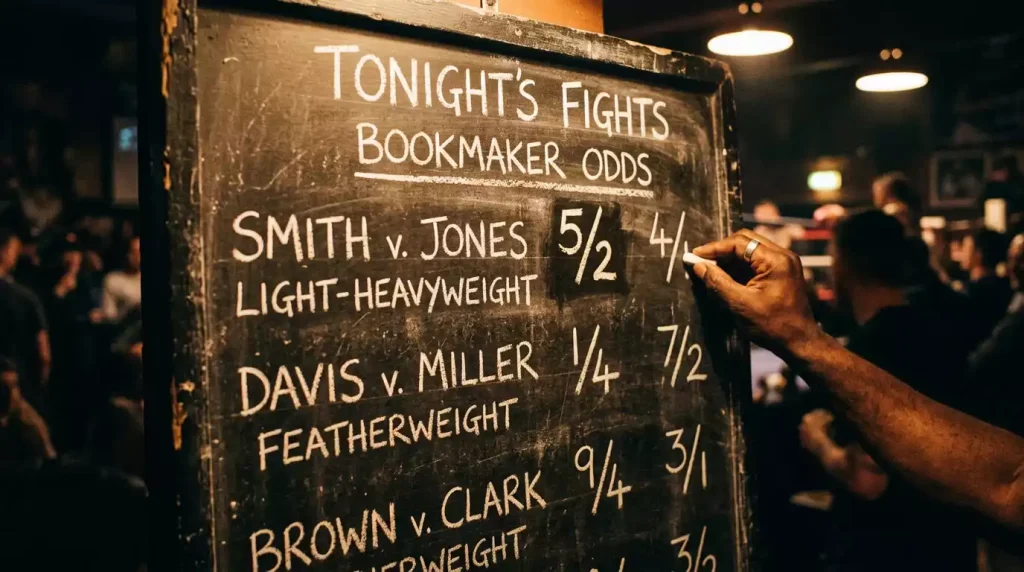
I have found exchanges particularly useful for championship fights where the favourite is priced below 1/4 at traditional bookmakers. At those prices, the margin embedded in the traditional operator’s odds eats a significant percentage of your potential profit. On an exchange, the same fighter might be available at a materially better price because you are matching against someone willing to lay the outcome at tighter margins. The commission still applies, but on odds-on selections it is almost always cheaper than the traditional bookmaker’s built-in overround.
Specialist and Mid-Size Operators
A tier of mid-size UK operators has carved out strong positions in combat sports specifically. These platforms sometimes offer niche markets — like fighter to score a knockdown in a specific round, or exact method sub-categories (body shot KO, cut stoppage) — that larger operators do not. Their odds can be competitive because they attract less public money and therefore face less pressure to widen overrounds. The trade-off is that their in-play offering and mobile experience may lag behind the market leaders, and their liquidity on undercard markets is often limited.
What makes specialist operators worth monitoring is their willingness to price fights that the big platforms overlook entirely. Small-hall shows, international cards without UK broadcasting deals, and prospect-level bouts on streaming platforms sometimes only appear at these niche bookmakers. If your boxing betting extends beyond the headline PPV cards, maintaining an account at a specialist operator fills gaps that the traditional giants leave open.
What Matters More Than the Name on the App
After nine years of comparing platforms, my conclusion is that no single operator deserves your exclusive loyalty for boxing. The sharp approach is to maintain accounts at three to five UKGC-licensed operators across these categories and select the best-priced option for each specific fight. That approach takes five extra minutes per bet and, over the course of a year, adds percentage points to your return on investment that no amount of analytical skill can replicate. The integration of live streaming into betting platforms has boosted engagement metrics by 25% across the industry, and that streaming access is an additional factor — some operators offer free in-app streams of fights to funded accounts, which eliminates the cost of a separate PPV subscription and lets you watch and bet from the same screen.
Comparing Boxing Odds Across UK Bookmakers
I keep a spreadsheet. It is not glamorous, and it will never go viral, but it has made me more money than any single analytical insight I have ever had about a fight. The spreadsheet logs the opening odds for every fighter I consider betting on across four UK bookmakers, then records the price I actually got when I placed the bet and the closing price at fight time. Over two years of data, the average difference between the best and worst available price on the same moneyline selection was 7.3% in implied-probability terms. On a 100-pound stake, that difference is the gap between a long-term profit and a long-term loss.
Odds comparison for boxing works differently from football because of timing. Football odds are available days or weeks before a match, giving the market time to settle. Boxing odds often shift dramatically in the final 48 hours — after the weigh-in, after the final press conference, after the last public workout. The price you see on Monday might bear little resemblance to the price at bell time on Saturday. This compressed timeline means boxing line shopping is most valuable when done in two passes: once when odds first open (to identify early value) and once in the final hours before the fight (to capture any late market corrections).
UK bookmakers pay a General Betting Duty of 15% on their net profits, and that tax obligation is uniform across all operators. What varies is how each operator manages their margin to accommodate that duty. Some maintain tighter overrounds and accept slimmer margins; others pad their prices more aggressively. The result is a structural incentive for you to compare — because operators do not all respond to the same tax burden in the same way, persistent price differences exist across the market.
Odds aggregation tools help. Several free websites and apps pull boxing odds from multiple UK bookmakers into a single view, letting you spot the best price in seconds. These tools are not perfect — they sometimes lag behind real-time prices by a few minutes, which matters during rapid pre-fight movement — but they are a massive time-saver compared to logging into each operator’s app individually. If you are serious about boxing betting and not already using an odds comparison tool, you are leaving money on the table with every bet.
There is a behavioural dimension to odds comparison that deserves mention. Most casual bettors default to whichever app they opened first — usually the operator whose advertising they saw most recently. That default behaviour is precisely what allows price differences to persist across the market. If every bettor compared odds before every bet, the differences would narrow to near-zero within minutes of a market opening. The fact that they do not is the structural inefficiency that line shopping exploits, and it works because human laziness is more reliable than any statistical model.
Mobile Betting and Boxing Apps
Three-quarters of UK punters aged 18 to 24 use a mobile phone as their primary gambling device. For boxing betting, where fights happen on Saturday nights and the best in-play opportunities last only the sixty seconds between rounds, mobile is not a convenience — it is the primary interface. If a bookmaker’s app is slow, cluttered, or difficult to navigate under time pressure, that operator is functionally unsuitable for live boxing betting regardless of how good their prices are.
What separates a good boxing betting app from a mediocre one? Navigation speed is paramount. Can you move from the main event moneyline to an undercard round-betting market in under three taps? Does the app load in-play odds without a noticeable refresh delay? Can you switch between fractional, decimal, and American formats without leaving the bet slip? These micro-interactions sound trivial, but during a live fight they are the difference between catching a price and watching it evaporate.
Push notifications are a double-edged feature. Most apps will alert you to pre-fight odds boosts, new market availability, and fight results. Used selectively, these are useful — an alert that a new in-play market has opened during a fight can flag an opportunity you might otherwise miss. Used indiscriminately, they are distracting noise designed to push you toward impulsive bets. I configure notifications tightly: fight-start alerts and in-play market availability only. Everything else gets turned off.
One factor that rarely gets discussed: battery and data consumption. Streaming a fight through a bookmaker’s app while simultaneously placing in-play bets is resource-intensive. Some apps handle this gracefully; others drain a full battery charge in under an hour or stutter when switching between the stream and the bet slip. If you plan to use a single device for both watching and betting, test the app’s performance under load before fight night — not during it.
Screen size also shapes the mobile boxing betting experience more than most people realise. On a 6.5-inch phone, a round-betting market with 26 selections requires significant scrolling. On a tablet, the same market displays as a clean grid you can scan in seconds. If you regularly bet round markets or method of victory — markets with many selections — consider whether your device is actually suited to the task. I switched to using a tablet for pre-fight bet placement two years ago, and the reduction in misclicks and missed prices was immediate.
Deposits, Withdrawals, and Payout Speed
Getting money into a betting account is rarely the problem. Every UK operator accepts debit cards, bank transfers, and major e-wallets, and deposits are typically instant. The real test is getting money out — and this is where operators diverge in ways that matter.
Payout speed for boxing winnings varies from minutes to several business days depending on the operator, the withdrawal method, and the amount. E-wallet withdrawals (PayPal, Skrill, Neteller) are consistently the fastest, often processed within hours. Debit card withdrawals take one to three business days at most operators. Bank transfers can take up to five. For bettors who manage their bankroll actively — redeploying winnings from one fight to the next on the same card — fast payout processing is not a luxury. It is a functional requirement.
Withdrawal limits are another consideration. Some operators cap the amount you can withdraw in a single transaction or within a 24-hour period. For recreational bettors this rarely matters, but if you land a significant accumulator payout or a high-stakes single, a low withdrawal cap means your money sits in the operator’s account longer than necessary. Check the terms before you need them, not after.
One practical tip I wish someone had told me years ago: keep your verification documents current and on file with every operator before you win big. UK anti-money-laundering requirements mean operators must verify your identity before processing withdrawals above certain thresholds. If your verification lapses or your details have changed, a large withdrawal can be delayed by days while you resubmit documents. Handle that paperwork proactively and fight-night payouts will arrive without friction. For a broader look at how free bet offers can supplement your boxing bankroll, the guide to boxing free bets and offers covers the details.
Boxing Betting Sites FAQ
Articles

Prepared by the RINGWAGER editorial staff.
