
Boxing Betting for Beginners: From Your First Bet to Your First Win
 Available in US
I remember my first boxing bet like it was yesterday — and not because it went well. I backed Dillian Whyte at absurd odds without understanding what fractional pricing actually meant, staked far too much, and watched my money evaporate inside four rounds. That was nine years ago. Since then, I have placed thousands of boxing bets, built systems that work, and learned that almost every beginner makes the same handful of mistakes I did. This guide exists so you skip the expensive lessons.
Boxing is one of the purest sports for betting. Two fighters, one ring, a limited set of outcomes. No team dynamics to muddle the analysis, no weather delays, no drawn-out league tables. Roughly 10% of the UK adult population bets on sport online, and a growing share of that activity flows toward combat sports precisely because the variables are manageable. But “manageable” does not mean “easy.” You still need a method, and that starts with choosing where to bet.
Choosing Your First Boxing Bookmaker
The first time I walked into a betting shop to put money on a fight, the guy behind the counter looked at me like I had asked for directions to the moon. Retail shops handle boxing, but the real action — the range of markets, the competitive odds, the live betting — lives online. Your choice of bookmaker shapes every bet you place, so treat this step seriously.
There are currently 5,825 licensed betting premises in the UK, a figure that has dropped 17.8% over the past decade as the industry shifts digital. Online is where you want to be for boxing. Here is what to look for when picking your first platform. Does the site hold a UK Gambling Commission licence? That is non-negotiable — it means your funds are protected, disputes have a resolution path, and the operator meets responsible gambling standards. Next, check the boxing market depth. Some bookmakers list the headline fight and nothing else. Others cover the full card, including undercard bouts and prop markets. You want the latter, even as a beginner, because more markets mean more learning opportunities.
Look at the odds format defaults. Most UK bookmakers display fractional odds by default — 5/1, 11/4, 2/9 — but every major platform lets you switch to decimal in your account settings. Decimal is easier to learn with, so toggle it early and save yourself mental arithmetic. Finally, check whether the bookmaker offers a boxing-specific section or lumps fights under a generic “combat sports” tab. Dedicated sections usually mean better market coverage and faster settlement.
Do not chase the biggest welcome bonus. A flashy sign-up offer means nothing if the bookmaker’s boxing odds are consistently below market average. Open accounts with two or three licensed operators, compare their odds on the same fight, and you will quickly see who prices boxing competitively. That comparison habit alone puts you ahead of most beginners.
Placing Your First Boxing Bet Step by Step
Three-quarters of UK bettors aged 18 to 24 use their mobile phone to gamble, and boxing is perfectly suited to mobile betting — you are usually watching the fight on a screen anyway. Here is how to place your first bet without fumbling.
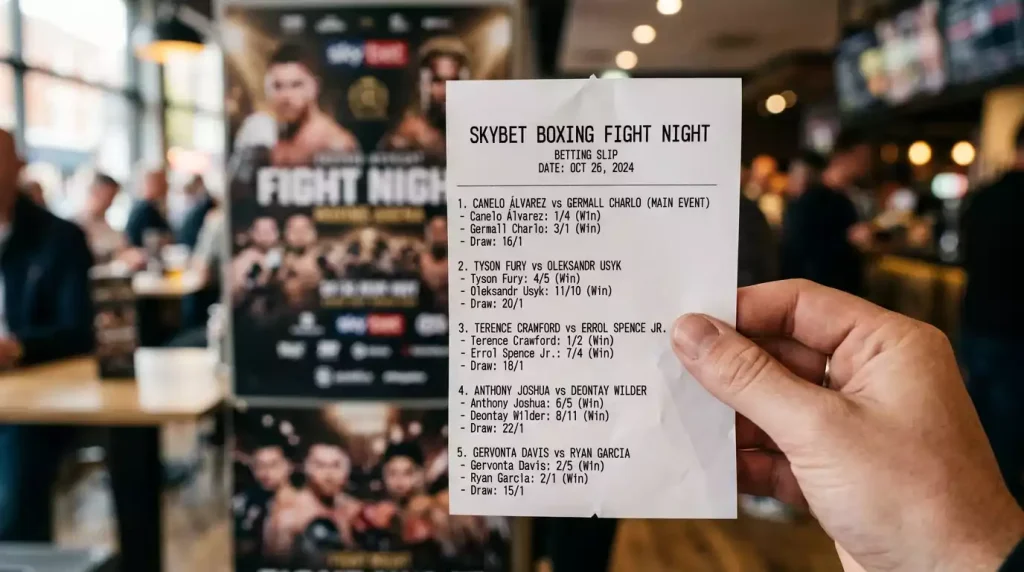
Step one: pick a fight. Do not start with a mega-event where the favourite is priced at 1/20 and the returns are negligible. Look for a competitive matchup on a mid-tier card where the odds offer some spread between the two fighters. Step two: decide on a market. For your first bet, stick with the moneyline — simply picking who wins. It is the most straightforward market and the best place to build confidence. Step three: check the odds across your bookmaker accounts. Even a small difference matters. If one site has Fighter A at 6/4 and another has them at 7/4, the second site gives you better value on the same outcome. Step four: enter your stake. Start small. I mean genuinely small — one or two pounds. Your first bet is a lesson, not a payday. Step five: confirm the bet, screenshot the slip, and watch the fight.
After the fight, review what happened regardless of whether you won. Did the outcome match your reasoning, or did you get lucky? Did you spot anything during the fight that you missed in your research? Write a sentence or two about it. That log becomes invaluable over time. I still keep mine in a spreadsheet, and the entries from my first year are embarrassingly thin — but they taught me patterns I would never have noticed otherwise.
Once you are comfortable with moneyline bets, explore the over/under rounds market. It asks whether the fight will last longer or shorter than a set number of rounds, and it forces you to think about fighter styles rather than just who wins. That analytical shift is where real improvement starts. For a deeper look at how odds translate into probability, the guide to boxing odds breaks down every format used in UK betting.
Five Mistakes Every Boxing Betting Beginner Makes
I have made all five of these. Every single one. So this is not theory — it is a post-mortem on my own early losses.
Mistake one: betting on every fight. When you first discover boxing betting, the temptation is to have action on every card. Resist it. Most fights on a given card do not offer value at the posted odds. Selective betting is not boring; it is profitable. I spent my first six months betting on every Saturday night card and my record was atrocious. The moment I started skipping fights where I had no edge, my results improved overnight.
Mistake two: ignoring the undercard. Beginners gravitate to the main event because that is what the media covers. But bookmakers price main events with surgical precision because the betting volume is enormous. Undercard fights, by contrast, receive less public attention and less sharp money, which means the odds are more likely to contain errors you can exploit.
Mistake three: chasing losses mid-card. A boxing card runs several fights in sequence, and if your first two bets lose, the urge to increase your stake on the third fight is overwhelming. Do not do it. Each fight is an independent event. The universe does not owe you a winner because you lost earlier in the evening. This pattern — chasing losses — is one of the clearest markers of problem gambling. Around 2.7% of UK adults experience gambling harm, and impulsive staking during a live event is a common trigger. Set your stakes before the card begins and do not adjust them mid-evening.
Mistake four: backing the favourite without checking the odds. A fighter can be the “right” pick and still be a terrible bet if the odds are too short. If a favourite is priced at 1/8, you need to stake eight pounds to win one pound. Unless you are extremely confident that fighter wins more than 88% of the time, the mathematics are against you. Learning to separate “who wins” from “where is the value” is the single biggest leap a beginner makes.
Mistake five: skipping research entirely. I see it constantly — people pick fighters based on name recognition, social media hype, or which corner looked more intimidating during the ring walk. None of that predicts outcomes. Spend twenty minutes reading about the fighters’ recent form, their styles, and the specific matchup dynamics. Twenty minutes. That tiny investment of time separates informed betting from guessing.
When the Lessons Start Paying Off
Your first month of boxing betting should cost you almost nothing in real terms — small stakes, deliberate choices, and a growing notebook of observations. The goal is not to profit immediately. It is to build a process that eventually generates consistent results. Once you have placed ten or fifteen bets with a clear rationale behind each one, you will start seeing patterns in how you think about fights. That is the foundation everything else is built on. The money follows the method, never the other way around.
Articles



Written by the editors at RINGWAGER.
