
Boxing Matched Betting UK: Lock in Profit from Free Bets and Offers
 Available in US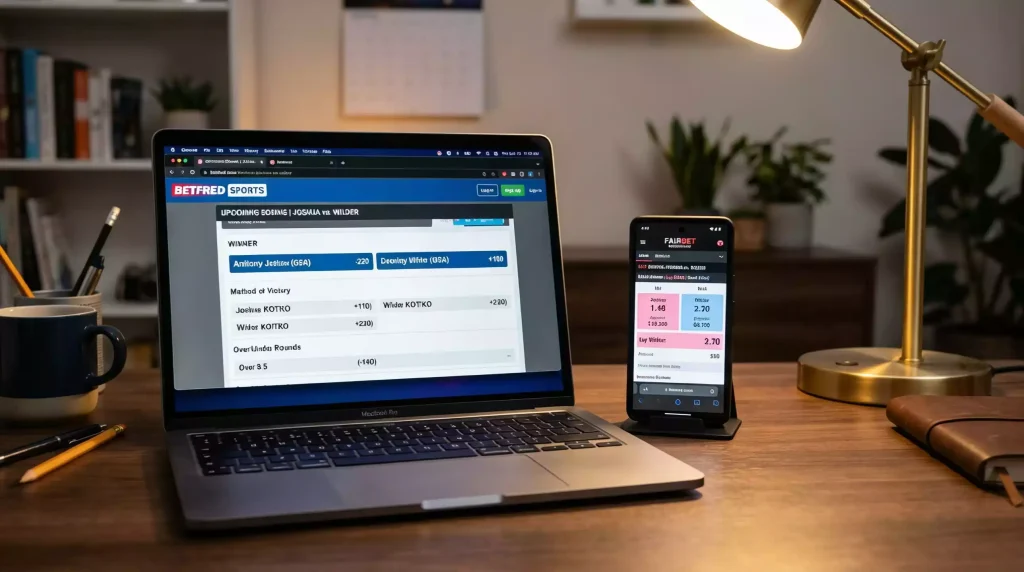
Matched betting is the closest thing to a guaranteed profit in sports betting, and boxing creates specific opportunities that other sports do not. The principle is straightforward: place a back bet with a bookmaker using a free bet or promotion, then lay the same outcome on a betting exchange to cover all results. The profit comes from the free bet value minus the small cost of the lay. I have used matched betting on boxing events for years as a low-risk way to extract cash from promotional offers, and this guide explains how to apply it to fight nights in the UK.
How Matched Betting Applies to Boxing
Around 290 million online bets are placed monthly in the UK, and the bookmakers facilitating that volume spend heavily on promotions to attract and retain customers. Every sign-up free bet, every enhanced odds offer, every bet-and-get promotion on a boxing card is a potential matched betting opportunity. The technique works because you are not gambling in the traditional sense — you are covering every outcome mechanically to guarantee a return regardless of the fight result.
Boxing is particularly suited to matched betting for two reasons. First, boxing markets are binary or near-binary. A moneyline market has two outcomes (or three if the draw is priced separately), which makes the back-and-lay structure simple. Compare that to horse racing, where a twelve-runner field creates complex liability calculations. In boxing, you back Fighter A with the bookmaker and lay Fighter A on the exchange. If Fighter A wins, the bookmaker pays you and the exchange takes your lay liability. If Fighter A loses, the exchange returns your lay stake and the bookmaker takes nothing because you used a free bet. The maths are clean.
Second, boxing events generate concentrated promotional activity. Major fight nights produce a surge of free bet offers across multiple bookmakers simultaneously, which means you can execute several matched betting operations in a single evening. On a recent heavyweight card, I processed four separate free bets from different bookmakers on four different fights — each one a straightforward back-and-lay that locked in between six and nine pounds of risk-free profit. Sixteen to thirty-six pounds for thirty minutes of work, with zero risk.
Finding and Placing Qualifying Bets on Boxing
Before you can use a free bet, most promotions require a qualifying bet — a real-money wager that triggers the free bet release. The qualifying bet is where your small cost arises, because you are placing a bet with the bookmaker and simultaneously laying it on the exchange, and the difference between the bookmaker’s odds and the exchange’s odds creates a minor loss. Your job is to minimise that loss.
For boxing qualifying bets, look for fights where the bookmaker’s odds and the exchange’s odds are as close as possible. The tighter the gap, the smaller your qualifying loss. Moneyline markets on competitive fights usually offer the best odds alignment because they attract the most liquidity on both platforms. Avoid qualifying on heavy favourites where the lay odds on the exchange carry a wide spread — the qualifying cost will eat into your eventual free bet profit.
Timing matters. Place your qualifying bet as close to fight time as possible, because odds convergence between bookmakers and exchanges improves as the event approaches. In the days before a fight, bookmaker odds and exchange odds can diverge by 10% or more. On fight day, that gap typically narrows to 2% to 4%, which keeps your qualifying cost low. Check both the bookmaker and the exchange simultaneously before confirming either bet, because odds can shift in the seconds between placements.
Using Betting Exchanges to Lay Boxing Outcomes
Andrew Rhodes, the chief executive of the UK Gambling Commission, has noted that if participation in gambling remains roughly stable while some products grow, it will be at the expense of other products. This dynamic plays out in boxing betting: as traditional bookmaker volume grows, exchange liquidity for boxing has fluctuated. That liquidity matters for matched betting because you need the exchange to have enough money available at acceptable odds to cover your lay.
The UK’s online gambling sector generated 7.8 billion pounds in GGY last year, and betting exchanges capture a portion of that through commission on winning bets rather than built-in margin on odds. For matched betting purposes, you need an exchange account alongside your bookmaker accounts. The exchange lets you act as the bookmaker — offering odds to other users rather than accepting them. When you “lay” Fighter A, you are betting that Fighter A will not win. If the fight ends in a draw or Fighter B wins, your lay bet wins.
The key variable in your lay bet is the liability — the amount you stand to lose if the lay bet loses (meaning Fighter A actually wins). On a free bet matched operation, your liability is covered by the free bet payout from the bookmaker. The maths work like this: if your ten-pound free bet on Fighter A at 4/1 wins, the bookmaker pays you forty pounds (stake not returned). Your lay liability on the exchange might be, say, thirty-eight pounds. Net result: two pounds profit. If Fighter A loses, your free bet costs you nothing (it was free) and your lay bet on the exchange wins, returning your lay stake minus commission — perhaps another three or four pounds. Either way, you profit.
Liquidity on boxing exchange markets is thinner than on football, which means you may need to wait for your lay bet to be matched, especially on undercard fights. On main events and title fights, exchange liquidity is usually sufficient for stakes up to a hundred pounds. On smaller shows, you might struggle to get matched above twenty or thirty pounds. Factor this into your planning — if the exchange cannot match your lay, the matched bet does not work.
For a broader look at free bet types and their terms, the boxing free bets and offers guide covers sign-up offers, enhanced odds, and wagering requirements in detail.
The Discipline Behind Risk-Free Returns
Matched betting on boxing is not exciting. It is administrative, precise, and profitable in small increments. The returns per operation are modest — five to fifteen pounds per free bet on average — but the risk is effectively zero when executed correctly. Over a year of consistent work across every major boxing card, those modest returns compound into a meaningful sum. I treat matched betting as a separate activity from my regular boxing analysis. It requires different skills: patience, accuracy, and the willingness to extract every penny of value from promotions that most bettors use carelessly or not at all.
Articles

Written by the editors at RINGWAGER.
